
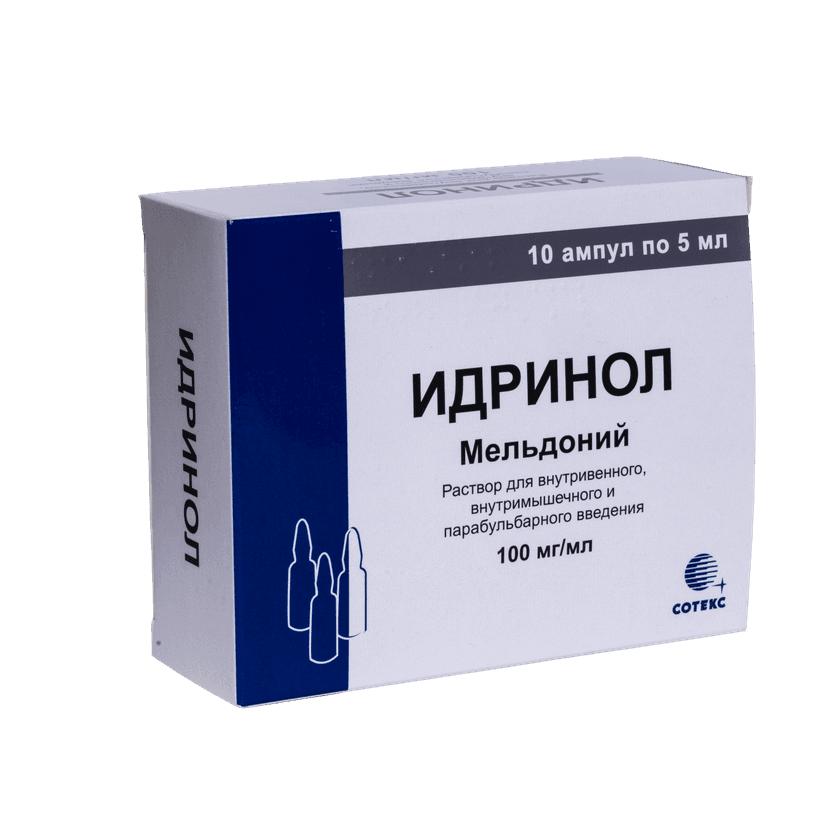
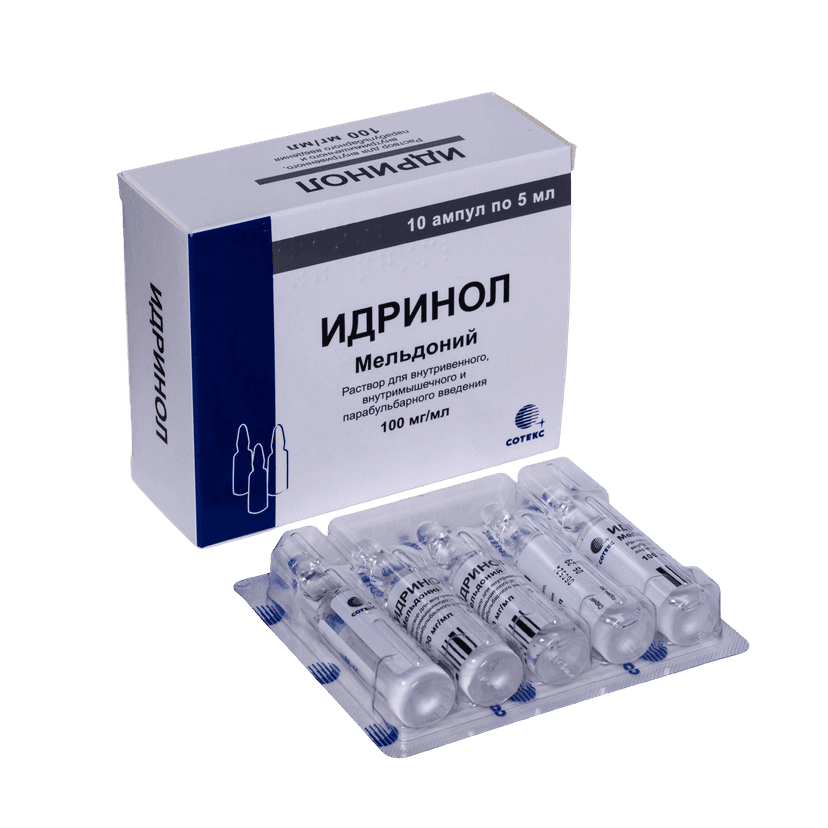
Composition: Per ampoule: active ingredient: meldonium dihydrate without adsorbed moisture — 500 mg (equivalent to anhydrous meldonium 401.05 mg). Excipient: water for injections up to 5 ml.
Form: Solution for intravenous, intramuscular, and parabulbar injection
Indications: • As part of combination treatment of coronary heart disease (angina, myocardial infarction), chronic heart failure and dyshormonal cardiomyopathy. • As part of combination treatment of acute cerebrovascular disorders (ischaemic stroke, cerebrovascular insufficiency). • Reduced performance, physical overexertion, including in athletes. • Withdrawal syndrome in chronic alcoholism, with specific treatment. • Haemophthalmos and retinal haemorrhages of various origins, thrombosis of the central retinal vein and its branches, retinopathies of various origins (diabetic, hypertensive).
Contraindications: • Hypersensitivity to the components. • Increased intracranial pressure due to impaired venous outflow or intracranial tumours. • Age under 18 years; efficacy and safety have not been established. Use with caution in liver and/or kidney disease.
Dosage: Because of a possible stimulating effect, use in the first half of the day is recommended. IDRINOL is administered intravenously (IV), intramuscularly (IM) or parabulbarly. Route, dose and duration are selected individually according to the indication, severity and other factors. Cardiovascular diseases, as part of combination treatment: • Myocardial infarction: 500–1000 mg daily by IV injection, in one or two administrations. • Stable angina, chronic heart failure and dyshormonal cardiomyopathy: 500–1000 mg/day by IV injection in one or two administrations, or 500 mg IM 1–2 times daily for 10–14 days, possibly followed by oral meldonium. Maximum course: 4–6 weeks. Cerebrovascular disorders: in the acute phase, 500 mg IV once daily for 10 days as part of combination treatment, possibly followed by oral meldonium 500–1000 mg. Maximum course: 4–6 weeks. For chronic cerebrovascular insufficiency (dyscirculatory encephalopathy), 500 mg IM or IV once daily for 10 days, possibly followed by oral meldonium 500 mg. Maximum course: 4–6 weeks. Repeat courses on a physician’s recommendation, usually 2–3 times a year. Eye disorders (haemophthalmos, retinal haemorrhages, central retinal vein/branch thrombosis, diabetic or hypertensive retinopathy): 50 mg parabulbarly for 10 days, including as part of combination treatment. Mental and physical overload: 500 mg IM or IV once daily for 10–14 days. If necessary, repeat after 2–3 weeks. Chronic alcoholism: 500 mg IM or IV twice daily for 7–10 days.
Side effects: Rare — tachycardia, agitation, hypo- or hypertension, dyspepsia, itching, rash. Very rare — eosinophilia, weakness.
Interactions: Compatible with antianginal agents, anticoagulants, diuretics, bronchodilators. Enhances the effect of cardiac glycosides. Use with caution with nitrates, antihypertensives, and vasodilators.
Warnings: Use only in the first half of the day due to possible stimulating effect. Not a first-line drug for acute coronary syndrome. Not recommended during pregnancy and lactation.
Age restrictions: 18+
Pregnancy: Not recommended during pregnancy and lactation due to insufficient safety data.
Country of origin: Russia
Manufacturer: Sotex
Storage conditions: Store at temperatures not exceeding 25°C. Do not freeze. Keep out of reach of children.
Therapeutic Archive 8, 2015
Authors: A.S. Skotnikov, G.N. Gorokhovskaya, A.M. Shilov, V.L. Yun, M.A. Khamurzova
ReadHeart Failure, 2017
Authors: G.N. Gorokhovskaya, MD, Prof. V.L. Yun, A.S. Skotnikov, MD, A.I. Martynov, MD, Prof. E.Yu. Maychuk, MD
Read