
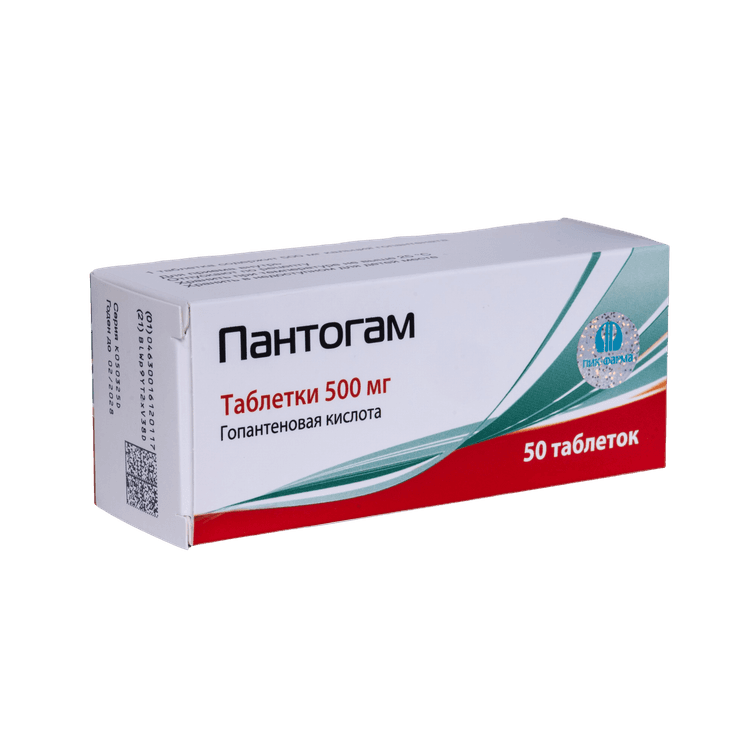
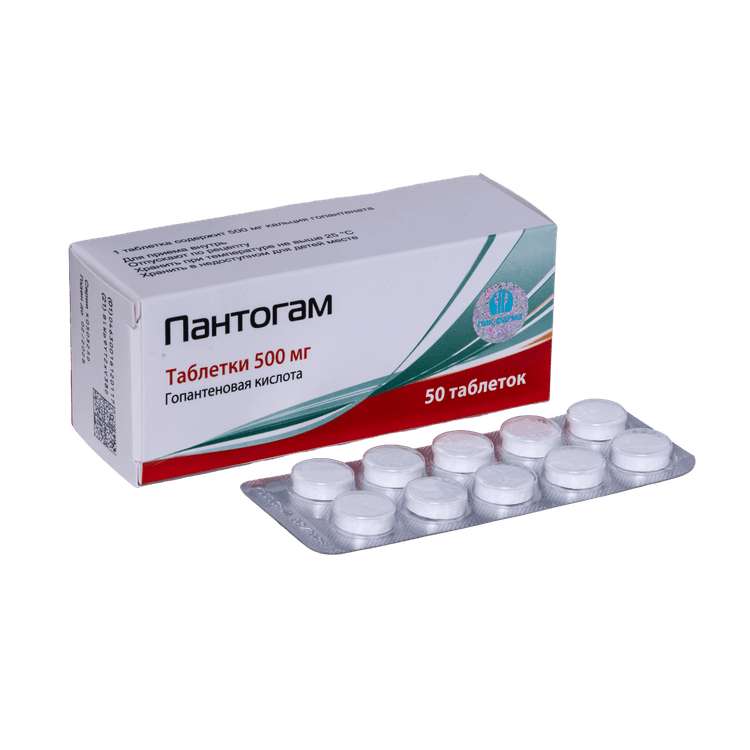
Composition: One tablet contains: active ingredient: calcium hopantenate (Pantogam®) 500 mg. Excipients: methylcellulose 1.6 mg, calcium stearate 6.2 mg, magnesium hydroxycarbonate 93.6 mg, talc 18.6 mg.
Form: Tablets
Indications: • Cognitive impairment in organic brain lesions, including sequelae of neuroinfections and traumatic brain injury, and neurotic disorders. • Schizophrenia with cerebral organic insufficiency. • Cerebrovascular insufficiency caused by atherosclerotic changes in cerebral vessels. • Extrapyramidal disorders (myoclonus epilepsy, Huntington’s chorea, hepatolenticular degeneration, Parkinson’s disease and others); treatment and prevention of antipsychotic-induced extrapyramidal syndrome (hyperkinetic and akinetic). • Epilepsy with slowing of mental processes, with anticonvulsants. • Psychoemotional overload, reduced mental and physical performance, to improve concentration and memory. • Neurogenic urinary disorders (pollakiuria, imperative urges, urge incontinence, enuresis). • Children with developmental delay (mental, speech, motor or combined), including after perinatal encephalopathy. • Various forms of cerebral palsy in children. • Hyperkinetic disorders in children, including attention-deficit hyperactivity disorder. • Neurosis-like conditions in children (tics, stuttering, mainly the clonic form). Used in children over 3 years. Syrup is recommended at a younger age.
Contraindications: Hypersensitivity, acute severe kidney diseases, pregnancy and breastfeeding.
Dosage: Orally, 15–30 minutes after meals. The usual single dose is 0.25–1 g for adults and 0.25–0.5 g for children; daily dose: 1.5–3 g for adults and 0.75–3 g for children. Treatment lasts 1–4 months, sometimes up to 6 months. A repeat course is possible after 3–6 months. Epilepsy, with anticonvulsants: 0.75–1 g daily for up to 1 year or longer. Extrapyramidal neuroleptic syndrome, with ongoing treatment: up to 3 g daily for several months. Extrapyramidal hyperkinesias in hereditary nervous system diseases, with ongoing treatment: 0.5–3 g daily for up to 4 months or longer. Sequelae of neuroinfections and traumatic brain injury: 0.25 g 3–4 times daily. Psychoemotional overload, reduced performance, improving concentration and memory, asthenic conditions: 0.25 g 3 times daily. Treatment and prevention of antipsychotic-induced extrapyramidal syndrome: adults 0.5–1 g 3 times daily; children 0.25–0.5 g 3–4 times daily, for 1–3 months. Tics in children: 0.25–0.5 g 3–6 times daily for 1–4 months. Urinary disorders: adults 0.5–1 g 2–3 times daily; children 0.25–0.5 g (daily dose 25–50 mg/kg), for 1–3 months. Children with various nervous system disorders: 1–3 g according to age. Increase the dose over 7–12 days, maintain the maximum for 15–40 days and taper to discontinuation over 7–8 days. Interval between courses: 1–3 months. Concomitant nootropics or stimulants are not recommended during prolonged treatment. Prefer morning and daytime administration.
Warnings: Use only as prescribed by a doctor. Not recommended with other nootropics or stimulants.
Age restrictions: Used in children over 3 years. Syrup is recommended at a younger age.
Pregnancy: Contraindicated during pregnancy and lactation
Country of origin: Russia
Manufacturer: PIK-PHARMA
Storage conditions: Store at a temperature not exceeding 25°C in a dry, dark place. Keep out of reach of children.
FARMATEKA, 2013
Authors: N.N. Zavadenko, E.V. Kozlova
ReadJournal of Neurology and Psychiatry named after S.S. Korsakov, 2022
Authors: L.S. Chutko, S.Yu. Surushkina, E.A. Yakovenko
ReadJournal of Neurology and Psychiatry named after S.S. Korsakov, 2018
Authors: N.N. Zavadenko, N.Yu. Suvorinova, A.N. Zavadenko
ReadConsilium Medicum, 2018
Authors: N.N. Zavadenko, N.Yu. Suvorinova, A.N. Zavadenko
Read