
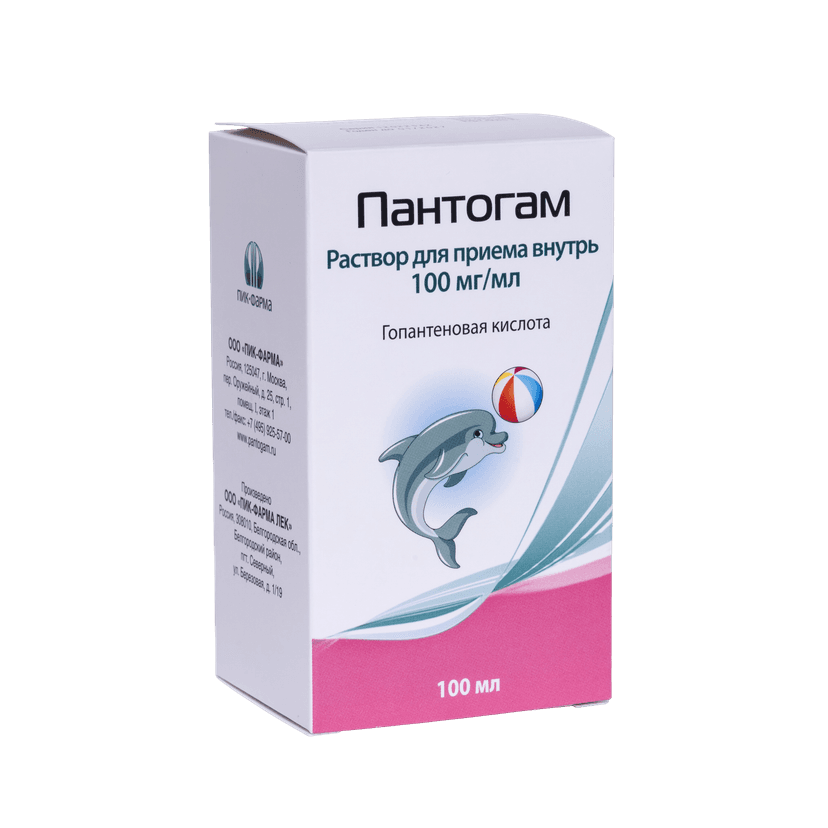
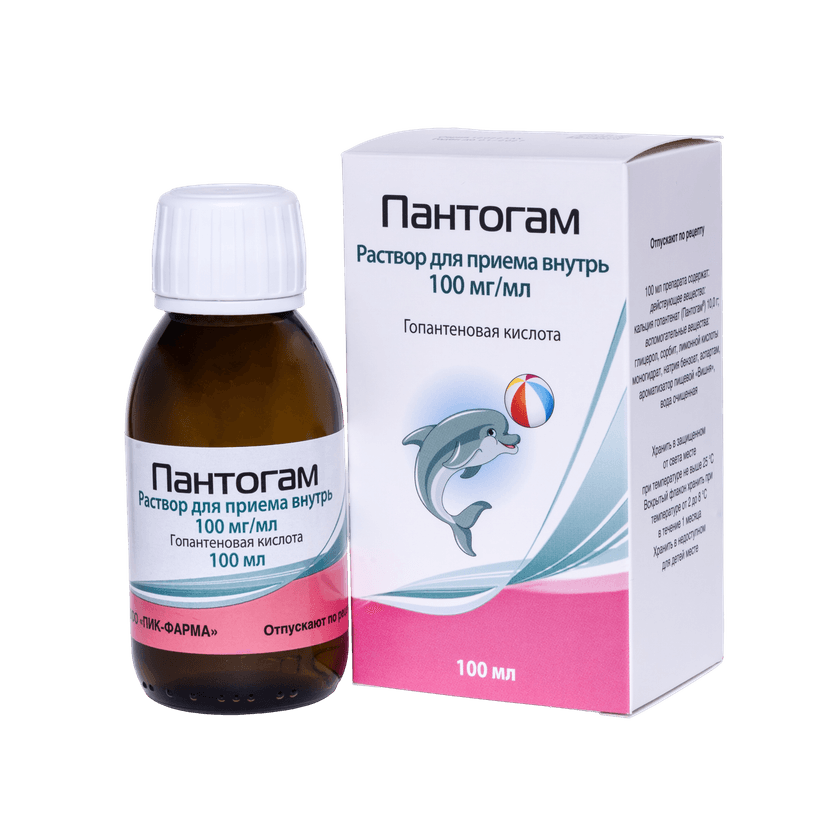
Composition: 100 ml contains: active ingredient: calcium hopantenate (Pantogam®) 10.0 g. Excipients: glycerol (calculated as 100%) 25.8 g, sorbitol 15.0 g, citric acid monohydrate 0.1 g, sodium benzoate 0.1 g, aspartame 0.05 g, cherry food flavouring 0.01 g, purified water up to 100 ml.
Form: Oral solution.
Indications: Perinatal encephalopathy, cerebral palsy, intellectual disability with/without behavioral disorders, delayed mental development and formation of school skills, hyperkinetic disorders and attention deficit syndrome, neurotic-like conditions, organic lesions of the CNS, epilepsy with slowed mental processes, neurogenic urinary disorders.
Contraindications: Hypersensitivity to the medicine, acute severe kidney diseases, pregnancy (first trimester), phenylketonuria (the oral solution contains aspartame).
Dosage: Take orally 15–30 minutes after meals. Usual single dose: adults 2.5–15 ml (0.25–1.5 g), children 1–15 ml (0.1–1.5 g). Daily dose: adults 5–30 ml (0.5–3 g), children 1–30 ml (0.1–3 g). Treatment course: 1–4 months, sometimes up to 6 months. Repeat after 3–6 months if required. Depending on age and nervous system pathology, the recommended daily dose for children is 30–50 mg/kg body weight, administered 1–2 times daily. The 5 ml measuring spoon is marked at 1, 2, 2.5, 3 and 4 ml. One ml contains 100 mg of active ingredient. Child’s weight — daily dose (mg; ml): 3.3–6.0 kg — 100–400 mg; 1–4 ml. 6.6–10.0 kg — 200–500 mg; 2–5 ml. 10.0–12.0 kg — 300–600 mg; 3–6 ml. 13.3–16.0 kg — 400–800 mg; 4–8 ml. 16.6–20.0 kg — 500–1000 mg; 5–10 ml. 20.0–28.0 kg — 600–1400 mg; 6–14 ml. 27.0–40.0 kg — 800–2000 mg; 8–20 ml. 40.0–60.0 kg — 1200–3000 mg; 12–30 ml. Over 60 kg — 1800–3000 mg; 18–30 ml. Increase the dose over 7 days, maintain the recommended dose for the main course, then taper over 7 days. The course lasts 1–3 months, or up to 6 months or longer for certain diseases. Schizophrenia with psychotropic medicines: 5–30 ml (0.5–3 g) daily for 1–3 months. Epilepsy with anticonvulsants: 7.5–10 ml (0.75–1 g) daily for up to 1 year or longer. Neuroleptic syndrome with extrapyramidal disorders: up to 30 ml (3 g) daily for several months. Extrapyramidal hyperkinesias in organic nervous system diseases: 5–30 ml (0.5–3 g) daily for up to 4 months or longer. Sequelae of neuroinfections and traumatic brain injury: 5–30 ml (0.5–3 g) daily. Restoring performance under increased workloads and in asthenic conditions: 2.5–5 ml (0.25–0.5 g) 3 times daily. Urinary disorders: children 2.5–5 ml (0.25–0.5 g) 1–2 times daily, daily dose 25–50 mg/kg, for 2–3 months; adults 5–10 ml (0.5–1 g) 2–3 times daily. Prefer morning and daytime administration.
Side effects: Allergic reactions (rhinitis, conjunctivitis, rash). Very rarely — hyperexcitability, sleep disturbances or drowsiness, lethargy, headache, dizziness, ringing in the ears.
Interactions: Prolongs the action of barbiturates, enhances the effect of anticonvulsants (phenobarbital, carbamazepine, neuroleptics), etidronic acid and glycine; potentiates the effect of local anesthetics.
Warnings: Do not use after the expiration date. Keep out of reach of children.
Age restrictions: From birth (as indicated)
Pregnancy: Use during pregnancy and breastfeeding is not recommended because there is no clinical experience in these patients.
Country of origin: Russia
Manufacturer: PIK-PHARMA LEK LLC, 1/19 Beryozovaya Street, Severny settlement, Belgorod district, Belgorod region, Russia, 308010.
Storage conditions: Store protected from light at a temperature not exceeding 25°C. After opening, store at 2–8°C for 1 month. Keep out of reach of children.
Shelf life: 2 years. Do not use after the expiry date.
Dispensing conditions: Prescription only.
Journal of Neurology and Psychiatry named after S.S. Korsakov, 2018
Authors: L.A. Davydova, N.N. Zavadenko
ReadRussian Medical Journal, 2017
Authors: L.S. Chutko, MD, S.Yu. Surushkina, PhD, E.A. Yakovenko, PhD, T.I. Anisimova, A.V. Sergeev
ReadJournal of Neurology and Psychiatry, 2013
Authors: G.S. Golosnaya
Read