
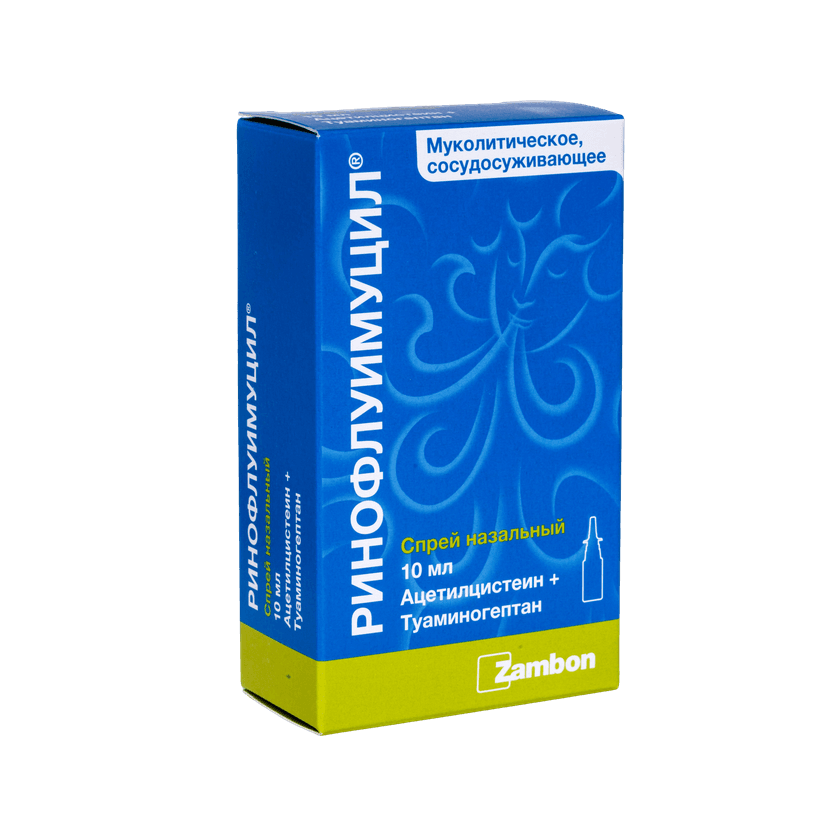
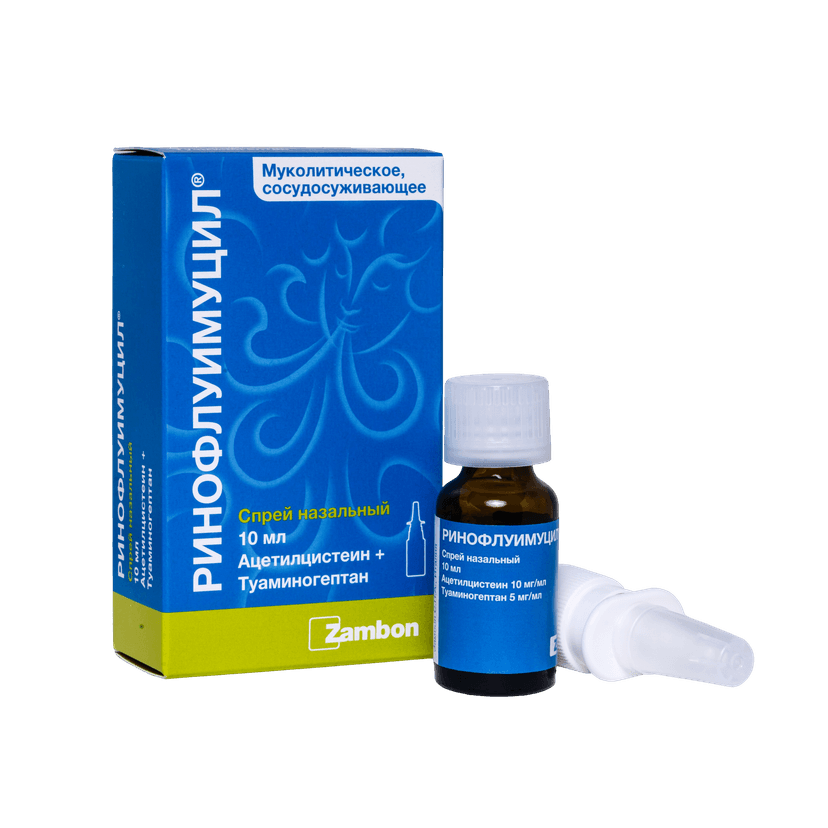
Composition: 100 ml of solution contains: Active ingredients: acetylcysteine — 1.0 g; tuaminoheptane sulphate — 0.5 g. Excipients: benzalkonium chloride 0.01 g; hypromellose 0.75 g; disodium edetate 0.02 g; sodium dihydrogen phosphate 0.3 g; disodium hydrogen phosphate dodecahydrate 0.3 g; dithiothreitol 0.1 g; sorbitol 70% 2.0 g; mint flavouring 0.0188 g; ethanol 96% 0.31 g; sodium hydroxide 0.36 g; purified water up to 100 ml.
Form: Nasal spray.
Indications: Acute and subacute rhinitis with thick purulent-mucous secretions, chronic rhinitis, vasomotor rhinitis, atrophic rhinitis and sinusitis.
Contraindications: • Hypersensitivity to the active ingredient or any excipient. • Cardiovascular diseases, including hypertension. • History of cerebrovascular disease, including relevant risk factors, due to alpha-sympathomimetic activity. • History of seizures. • Phaeochromocytoma. • Angle-closure glaucoma. • Concomitant use of other sympathomimetic nasal medicines, including other decongestants. • Current use of monoamine oxidase inhibitors, including reversible monoamine oxidase A inhibitors (RIMA), or use within the previous 2 weeks. • Hypophysectomy or surgery exposing the dura mater. • Children under 6 years of age. Use with caution: occlusive vascular diseases, diabetes mellitus, hyperthyroidism, asthma, prostatic hypertrophy (may make urination difficult), beta-blocker use. Prolonged use may cause recurrent congestion and drug-induced rhinitis.
Dosage: Administer into the nasal cavity as a spray using the special spray nozzle. Adults: 2 sprays (2 valve presses) into each nostril 3–4 times daily. Children over 6 years: 1 spray (1 valve press) into each nostril 3–4 times daily. Treatment must not exceed 7 days. Do not exceed the recommended dose or duration without consulting a physician. Spray instructions: 1. Remove the cap from the solution bottle. 2. Remove the protective cap from the spray nozzle (figure A in the leaflet). 3. Attach the spray nozzle to the bottle (figure Б). 4. Remove the nozzle cover (figure В). 5. Prime the spray nozzle by pressing repeatedly. 6. Spray (figure Г).
Side effects: Dryness in the nose and throat, headache, anxiety, tachycardia, insomnia, rash, urinary retention, dependency, allergic reactions.
Interactions: Do not combine with MAO inhibitors, antihypertensives, cardiac glycosides, oxytocin, ergot alkaloids, Parkinson’s disease medications.
Warnings: Do not use longer than 7 days. Use with caution in hypertension, diabetes, asthma, prostate adenoma, children and the elderly. Withdrawal symptoms possible after abrupt discontinuation. May cause a positive doping test.
Age restrictions: From 6 years
Pregnancy: Not recommended during pregnancy and lactation due to insufficient data.
Manufacturer: Zambon
Storage conditions: 15–25 °C, out of reach of children. Use within 20 days after opening.
Republican Specialized Scientific-Practical Medical Center of Otorhinolaryngology and Head & Neck Diseases, 2024
Authors: Khasanov U.S., Ergashev U.M., Shaumarov A.Z., Shodmonov Sh.A., Djangirov T.G., Khusnutdinov R.A., Urinov T.Sh., Jurakulov S.Z.
ReadBulletin of Otorhinolaryngology, 2023
Authors: A.V. Gurov, M.A. Yushkina, A.V. Muzhichkova
ReadRussian Otorhinolaryngology, 2008
Authors: A.G. Volkov, A.P. Davydova
ReadRussian Otorhinolaryngology, 2008
Authors: G.P. Zakharova, V.V. Shabalin
ReadRussian Otorhinolaryngology, 2008
Authors: G.P. Zakharova, V.V. Shabalin
ReadMinistry of Health of the Russian Federation, 2012
Authors: Ministry of Health of the Russian Federation
ReadKlinika, 2008
Authors: Chekan V.L.
ReadJAMA Supplement, Italian Edition, 1998
Authors: Giovanni Margarino
Read